
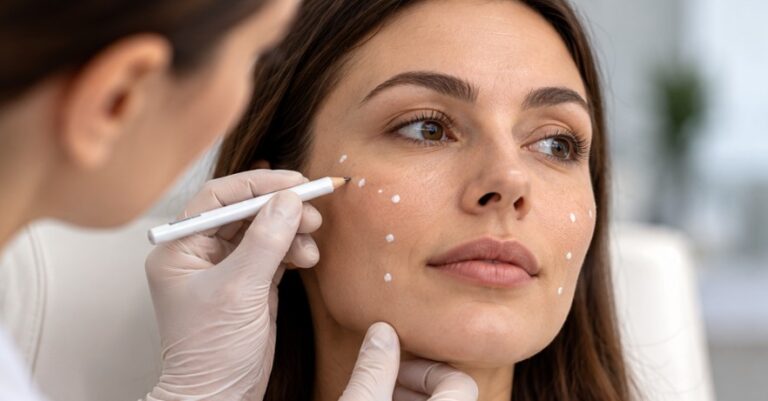
Before the needle comes out, someone marks your face. A white pencil, usually, held by a practised hand. Five small dots down one side. Five down the other. Then you sit in the chair looking at a face that has been turned into a constellation, and you think: that is all? Ten marks for a whole face?
It is a reasonable thing to wonder. If you have been reading about profhilo in Singapore, or any of the hyaluronic acid bio-remodelling treatments that work this way, you will have seen those five points per side described as a technique rather than a shortcut. The number is not an economy. It is the design. Understanding why changes what you should expect to see afterwards, and when.
The Instinct That More Is Better
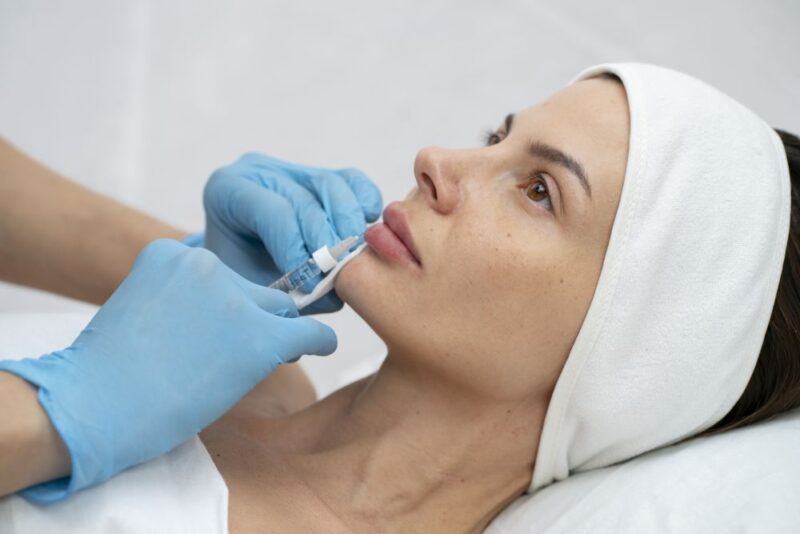
We carry an instinct into clinics that the amount of a thing is the value of it. More injections, more product, more visible activity. It is how we judge a plate of food or a tin of paint, and it feels like it ought to work for treatments too.
With some injectables that instinct is close to right. A dermal filler is placed exactly where the volume is wanted and largely stays there, so placement is a matter of millimetres and there may be a good many of them. The FDA explains how dermal fillers are used to create a smoother or fuller appearance in specific areas of the face.
With a spreading formulation the logic turns over. If the material is made to travel through the tissue, the work of the person holding the syringe is to choose a small number of places from which it can travel well.
What Spreading Actually Means
Picture a drop of water on a folded napkin rather than a drop of wax on a table. The wax sits where it lands and hardens into a bead. The water moves outward along the fibres and reaches further than a drop that size looks capable of reaching.
Certain hyaluronic acid preparations are formulated to behave more like the water. They are placed in a plane beneath the skin and diffuse outward across a region, which is why a handful of well chosen points can cover a cheek.
The points are not arbitrary. They are picked with the anatomy underneath in mind, both for where the material can travel from and for what lies nearby that a needle is better off avoiding.
Filling And Remodelling Are Different Jobs
This is the distinction most people arrive without. Filling is about shape. Remodelling is about the condition of the skin across an area. Hydration, elasticity, that loose quality along the jaw that is not really a line and not really a hollow.
A spreading treatment is aimed at the second job. It will not build a cheekbone. Pointed at one deep fold, it will disappoint, because it is not trying to push anything upward.
So the useful question at a consultation is not which product is better. It is which of those two jobs your face actually needs doing, and whether it needs one of them or both.
The Month That Confuses People
Here is the part that catches people out. Some of these hyaluronic acid products are metabolised by the body within roughly a month. The material you paid for is gone.
That sounds like a complaint and it is not. The intention is that the material does its work while it is present, and that the skin’s own response carries on after it has cleared. Clinics commonly suggest an initial pair of sessions about a month apart, with maintenance spaced a good deal further out.
Which means the mirror check at week one is measuring the wrong thing. And results vary from person to person regardless. Age, sun history, smoking, hydration and plain genetics all shape how much response there is to be had.
Worth Asking Before You Book
Ask narrower questions than you think you need to.
- Is this aimed at shape, at skin condition, or at both
- How many points, in which plane, and why those ones
- How many sessions to begin with, and how far apart
- When do we reassess, and what would count as no response
- What would you suggest instead if this is not the right fit
The last question matters most. A clear no is more useful to you than an enthusiastic yes.
Where It Fits Less Well

It is not a lift in the surgical sense, whatever the shorthand names suggest. Marked sagging is a structural matter, and a treatment aimed at skin quality is not a stand-in for addressing structure.
It is not a replacement for sun protection either, which quietly does more across a decade than most things done in a chair. The American Academy of Dermatology notes that regular sunscreen use helps reduce signs of premature skin aging.
For more on everyday skin care, this guide to simplifying a skin care routine also covers basic steps such as moisturising and daily sunscreen use.
Whether any of it suits you depends on your medical history, your allergies, what you have had done before and what you hope to change. That is a decision for a qualified doctor after an assessment in person.
I keep thinking about those ten white dots. They look like so little. A face is a broad thing, and ten points on it seem almost careless, the way a few stakes seem careless for a large tent.
But the stakes are not the tent. They are the places chosen to hold it up. Once you see the five points as a map rather than a quantity, the whole treatment reads differently. You stop counting the injections and start asking what they were for.